Mortality from All Causes and Life Expectancy
In 2023, life expectancy for Hispanic/Latino men was 78.5 years and for Hispanic/Latino women was 84. years (Office of Minority Health Reports, 2023). At 65 the life expectancy is 20.2 years for Hispanic Latino men and 22.6 years for Hispanic/Latino women. In 2018, the leading causes of death for older Hispanic/Latino men are: heart disease, cancer, stroke, diabetes, and Alzheimer’s Disease. The leading causes of death for older Hispanic/Latino women are: heart disease, cancer, Alzheimer’s Disease, stroke, and diabetes.
The Hispanic mortality paradox has received growing attention since the proposed epidemiological paradox for Mexican Americans in the Southwest proposed over twenty years ago by Markides and Coreil (1986). The Hispanic paradox can be defined as the health and mortality advantage that the Hispanic population has relative to the non-Hispanic White population and seems to be more salient in old age (Turra & Goldman, 2007; Markides & Eschbach, 2005; Franzini, Ribble, and Keddie, 2001). The Hispanic paradox refers to the long-observed pattern that Hispanics in the US often experience better health despite lower socioeconomic status. Given that globally lower socioeconomic status has been associated to poorer health outcomes.
Despite the evidence in the literature research shows that self-reports indicate that this population reports poorer health and greater disability which are inconsistent with the health advantage findings. It is suggested that the paradox in mortality patters does not apply to related health outcomes like disability (Eschback & Mark 2005). New findings regarding the Hispanic paradox show a mortality advantage with foreign born Hispanics compared to U.S. born with middle and older ages, occurs more with other Hispanics rather than Puerto Rican, and relevant to those who are of lower socioeconomic status (Turra & Goldman, 2007; Hayward et al., 2012; Nicole, 2023). Despite foreign-born being seen as a protective factor for health outcomes among Hispanic people a recent study found age of migration matter for disability (Vásquez et al., 2021). The study found that those who migrated at younger ages experienced higher initial disability.
According to Hayward et al. (2012) the advantage is more pronounced when controlling for income and education. Despite Hispanics low mortality rate the disability rates of foreign-born Hispanics seem to be higher than non-Hispanic Whites. Another perspective on disability among foreign-born Hispanics emphasizes characteristics unique to foreign-born Hispanics such as working in physically demanding jobs which require musculoskeletal demands and therefore elevated disability rates (Hayward et al., 2012). Blue and Fenelon (2011) offer a unique explanation linking the low mortality rates among Hispanics to their low smoking rates. Based on the H-EPESE study examining widowhood among older Mexican Americans and risk for mortality, findings revealed that the risk of dying is extended to 33 months for Mexican Americans compared to previous findings of 24 months (Stimpson, Kuo, Ray, Raji, Peek, 2007). Recent evidence shows that widowhood continues to be associated with increased mortaility risk among older adults, with the strongest effects oberved among Hispanic men (Liu, Umbersome & Xu 2020). Its important to note that for Hispanic people financial resources did not explain increased mortality risk after widowhood.
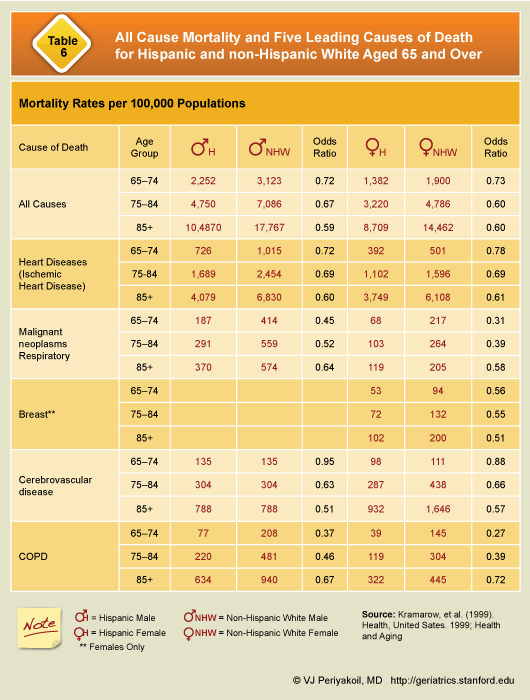
Table 6 shows the mortality rates comparing Hispanic/Latinos to non-Hispanic whites in the United States by gender and age group (65-74, 75-84, 85 + years) (Kramarow, Lentzer, Rooks, Weeks, & Saydah ,1999). For these three age groups, the all-cause mortality rates are about one-third lower in Hispanics. National surveys conducted by the U.S. Bureau of Census (Current Population Surveys) were matched to the National Death Index over a 9-year follow-up period; 40,000 Hispanics were included in the 700,000 respondents, age 25 years and older. Hispanics were shown to have a lower mortality from all causes than NHW (standardized rate ratio or SSR = 0.74 for men, and 0.82 for women (Sorlie, Backlund, Johnson, & Rogot, 1993).
These findings are consistent with observations reported from the National Health Interview Study (1986-1990) with 27,000 Hispanics and nearly 300,000 NHW interviewed. Deaths were determined by matching names to the National Death Index for a 5-year period through 1991. Age-adjusted total mortality rates per 100,000 person years were 2,466 for Hispanic men, 3,089 for NHW men, 1,581 for Hispanic women, and 1,897 for NHW women (Liao, et al., 1998).
The Hispanic/ non-Hispanic white mortality ratios for men were 1.33, 0.92, and 0.76 for men age 18–44, 45–65, and 65 +, respectively. The mortality ratios for women were 1.22, 0.75, and 0.70, respectively. These findings again suggest all-cause mortality is lower in Hispanics than NHW, especially in those over age 65 years.
Table 6 presents the mortality rates for 5 major causes of death comparing Hispanics to non-Hispanic whites in the United States by gender and age group (age 65–74,75–84, 85+ years) (Kramarow, et al., 1999). Each of the disease-specific mortality rates is lower in Hispanics than NHW.
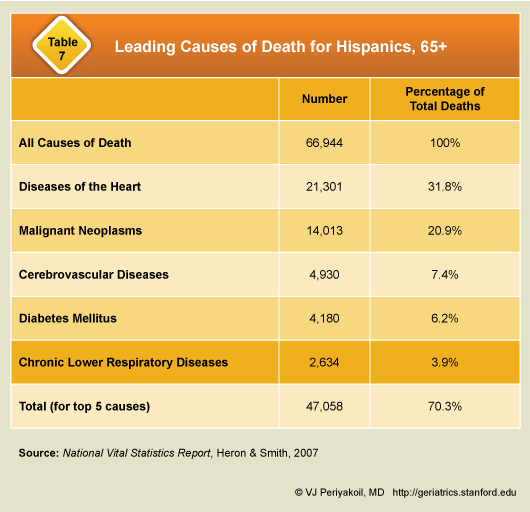
Table 7 shows the top five causes of death for older Hispanics explain 70% of all causes of death, suggesting that these diseases are critical for health prevention efforts. The other five diseases that are causes of death among Hispanics include influenza, pneumonia, Alzheimer’s Disease, nephritis, accidents (or unintentional injuries), and chronic liver disease (Heron & Smith, 2007).